Tuesday, December 21, 2010

From Friendster to Wikileaks: In Defense of Oversharing

So, I assume that by now you've heard about how Wikileaks is run by traitorous, anarchist terrorists who hate freedom. This is not going to be a post about how the US government's knee-jerk overreaction, its moronically overinflated rhetoric, or its Orwellian attempts to control what government employees can do in their own homes. You can probably guess my opinions, and others have written on the subject more knowledgeably and compellingly than I would.

I want to write about oversharing more generally.

I'm part of the generation that has spent much of the past five years hand-wringing and tooth-gnashing about how kids these days are posting pictures and videos of themselves drunk and naked, or with their mouths on things that – if only for hygienic reasons – mouths really shouldn't be on. We worry in print about these kids' futures. What will happen when a prospective employer or prospective spouse types their name into google twenty years from now? We worry that they fail to understand the consequences of youthful indiscretion in an age where every action is recorded and broadcast.

Don't get me wrong. I love my generation. Someday, when Ryan Seacrest is the NBC news anchor, he will hire James Frey to ghost-write a book about us called The Most Greatest Generation Ever! But somehow I feel that history will look back on us like the people who fretted about blue jeans, rock and roll music, and comic books. At least, I hope that is true.

I hope that the next generation, immersed as it is in oversharing, learns to admit that people are, well, human. The thing is, everyone does and says stupid things. Everyone always has. Yet, somehow, we've painted ourselves into this corner where we all have to pretend to be perfect (at least along certain, critical axes) in our public personas. People who aspire to politics carefully guard what they say for years, so as not to create a sound byte that can be used by their opponents. And somehow, we and the media jump on the bandwagon to vilify people for past indiscretions – even for things that we've done ourselves.

The result is that we have a country run predominantly by two sets of people: those who efficiently and ruthlessly fictionalize their own pasts, and those who have lived so carefully that you begin to question the extent to which they have lived at all.

I have done and said stupid and offensive and hurtful things. Am I proud of them? Of course not. But I hope that I have become smarter and better and kinder, and I hope to continue to become smarter and better and kinder in the future. Maybe if everyone's flaws and mistakes are cataloged on the internet, we can recognize that people are complicated and dynamic. Maybe we can learn to judge people based more on who they are and who they may become, rather than on random, isolated snapshots of who they were at some point in the past.

This is not a relativist argument. I believe that there are good people and bad people. I just think that we would all do a better job of identifying them if we did not have to place so much weight on the little slivers that leak out of the carefully constructed public shells.

The same argument goes for Wikileaks. The US government was embarrassed by the leaking of documents from the state department. Why? I honestly have no idea. Was anyone really surprised that internal memos spoke in frank terms about goals and objectives, about other countries and leaders? Was anyone really surprised to learn that the US uses its political muscle to promote the agendas of US corporations? Does anyone doubt that most of this is fairly vanilla behavior in the world of international diplomacy?

In a world filled with classified documents, fictions develop and take on a life of their own, spinning off their own morality. Governments pretend to be high-minded and moral, which turns out to be somewhat inconsistent with many of the things that real governments need to do in the real world. Then, something leaks out about some government activity, everyone pretends to be surprised and outraged, no matter how trivial or justifiable the infraction. Sometimes the infraction is only against this weird, artificial, fictional morality. But when the response is to enhance secrecy, to reinforce the fiction, it creates the opportunity for the government to do things that truly are horrific.

I have not spent a lot of time looking through the the latest Wikileaks documents, in part because most of them seem dreadfully boring. I'm glad that there are people who are reading these documents, pulling out the interesting bits, and cataloging them. It is conceivable to me that there will be pieces of information here and there that demand immediate action. However, my greater hope is that Wikileaks and its successors will allow us to make our peace with the messiness of government and diplomacy, so that we can focus our outrage on the big infractions.

Some of the Afghan leaks revealed certain atrocities, like the killing of civilians. Most of the reactions that I saw were some version of "It's just a few bad apples," "Leaking this will ruin our relationship with the Afghans," or "America is evil," all of which miss the point. I believe that the point should be that when you take tens of thousands of kids, some just barely out of high school, and put them halfway around the world in hellish conditions, bad things are going to happen. At some frequency, civilians, including children, are going to be killed. We need to focus on training and policies that keep those incidents to an absolute minimum. AND, we need to understand that this is a part of war, and part of the reason that military intervention needs to be the option of last resort. Secrecy leads to the romanticization of war. Currently, it seems that each generation has to rediscover the horrors of war for itself. Maybe additional transparency would let us hang on to those lessons for longer.

I was not in favor of Rand Paul (although his election has the silver lining of future comic potential), but I would have liked to see the media coverage focus more on his opposition to civil-rights legislation, and less on college pranks involving the "Aqua Bhudda." Maybe the future will contain copious footage of every Senate candidate being young, naked, and drunk. If we become desensitized to the salaciousness of it all, perhaps the media will cover the substantive philosophical and policy issues that distinguish the candidates.

The future that I am hoping for is not an entirely comfortable one, especially for those of us who came of age before the camera-phone panopticon. But, I want to trust the next generation to turn overshared lemons into lemonade.

In Arthur Miller's A View from the Bridge, the protagonist, Eddie Carbone lives with his wife, Beatrice, and his niece, Catherine. They house two of Beatrice's cousins, who are are in the country illegally for work. When Catherine falls in love with one of the cousins, Rodolpho, Eddie's romantic desires toward his own niece are revealed, and, acting out of jealousy, he turns the cousins over to immigration. The other cousin, Marco, has a starving family back in Italy, and deportation spells disaster for him. Eddie's betrayal of the cousins ruins him in his community and his family. In the end, Eddie and Marco fight in the street. Eddie pulls a knife, but dies after then knife is turned on him.

The family lawyer and narrator, Alfieri, closes with this:
Most of the time we settle for half and I like it better. But the truth is holy, and even as I know how wrong he was, and his death useless, I tremble, for I confess that something perversely pure calls to me from his memory – not purely good, but himself purely, for he allowed himself to be wholly known and for that I think I will love him more than all my sensible clients. And yet, it is better to settle for half, it must be! And so I mourn him – I admit it – with a certain . . . alarm.

Saturday, December 18, 2010

State-by-State FST(ish) Values: The Structure of Racial Diversity in America

So, in the world of population genetics, as in the real world, people are often interested in diversity, and in how that diversity is distributed. In biological contexts, quantifying these things is important because it gives us insight into the processes – like reproduction, migration, selection, etc. – responsible for generating the observed patterns of diversity.

Here I look at how racial diversity is apportioned among counties (or county equivalents) in each of the 50 states, using two different statistics derived from the population genetics and ecology literature. Hit the jump for the analysis, and scroll down to skip the introduction and go straight to the maps.

Monday, December 13, 2010

Where stalkers become friends: Geo-tagging on Flickr

So, you probably remember this from the most recent episode of The Mentalist / Bones / Castle / Criminal Minds / Numb3rs:

SEXY YET PROFESSIONAL DETECTIVE: What have we got?
SASSY JUNIOR DETECTIVE: Nothing. All of our leads have dried up like Cher's ovaries.
GRUFF SENIOR LAW ENFORCEMENT OFFICIAL: We've got to wrap this thing up. I've got the mayor breathing down my neck.
MAYOR: Hhhhhhhhhh. Hhhhhhhhhh.
G.S.L.E.O.: And now he's drooling.
S.Y.P.D.: We'll keep after it, but we're a bit short-handed after half of the department was beheaded and, ironically, eaten by The Vegan Killer.
G.S.L.E.O.: I don't want excuses. I want someone behind bars.
S.J.D.: You and my alcoholic ex wife.
SOCIALLY INAPPROPRIATE GENIUS: Actually, we know that the comptroller picked up his dry-cleaning on Wednesday. The same Wednesday that the chimney sweep showed up at the wedding in a curiously un-besooted pair of dungarees. Thus, the heiress was murdered by the delivery man who brought the Martinizing agents to the dry cleaners, also on Wednesday. Also, he was her half brother.
And, scene.

Thanks to research just published in PNAS by a group out of Cornell, we are now one step closer to living in a dystopian panopticon in which our associations can be inferred by any monkey with a laptop. Soon, Patrick Jane will be back to doing parlor tricks, Richard Castle will be back to making a living as an imaginary writer, and everyone else will be in prison for consorting with each other.

More specifically, the authors investigate whether they can infer a social connection between two people on the basis of their having been at the same place at the same time on multiple occasions, using data from Flickr. They look at 38 million pictures that contain both a timestamp and a geo-tag, indicating the time, latitude, and longitude at which the picture was taken. They define a co-occurrence of two Flickr users as having pictures taken within a time t of each other and within the same geographic region: a square(ish) region of length s latitude or longitude degrees on each side. The social dimension of the data comes from Flickr's networking functions, which allow users to specify their links to others. 

They find that the greater the number of co-occurrences for a pair of users, the more likely it is that they are friends. This is not particularly surprising, although the magnitude of the effects are quite striking. For example, here is one graph from the paper:

Part of Figure 2D from the paper. In this case, the spatial range for co-occurrence is defined by s = 1.0 degrees (about 55 miles by 65 miles where I live). The different curves correspond to different time windows.
The probability that two randomly selected Flickr users are friends is less than 1 in 7000 [Corrected. Original post said 1 in 700]. However, if two users have uploaded pictures from the same 1 degree by 1 degree region within a day of each other on five different occasions, there is nearly a 60% chance that they are friends. If they have done it more than eight times, the chance is more than 90%.

In other words, if you and your accomplice both upload photos from the same dry cleaner every Wednesday, even a non-genius will be able to figure out that you know each other. This is how Strangers on a Train will end in the 2032 remake starring Freddie Highmore and Abigail Breslin.

For those interested in looking at more pretty graphs, the article is Open Access, and can be found here.

For those interested in mounting a futile defense against the Orwellian State, more information about geo-tagging and privacy can be found here, including ways in which you may inadvertently be sharing location information without meaning to.


Crandall, D., Backstrom, L., Cosley, D., Suri, S., Huttenlocher, D., & Kleinberg, J. (2010). Inferring social ties from geographic coincidences Proceedings of the National Academy of Sciences DOI: 10.1073/pnas.1006155107

Saturday, December 11, 2010

You and I are going to the top of the charts!

So, a "supergroup" in the UK provided the latest British entry in the ongoing spectacle that I like to call, "What's Up with People?" This, from the guardian, via Boing Boing:

Later today, Pete Doherty, the Kooks, Billy Bragg, Imogen Heap, Orbital and many more will gather in a London studio, collaborating in a bid for this year's Christmas No 1. But the strangest bit is not the team-up: it's that they are not recording a single note. The ad hoc supergroup is assembling in support of Cage Against the Machine, a charity campaign to take John Cage's infamous 4'33" – a composition of pure silence – to the top of the Yuletide charts.

So many things.

First, referring to a collection of musicians as a "supergroup," when the headliners are Imogen Heap and the Kooks is like referring to the Pittsburgh Pirates' "All-Star lineup."

Second, doesn't a charity campaign to take a single to the top of the charts sound a bit like a McDonald's "charity" campaign to sell a lot of Happy Meals?

Third, am I going to be listed in the credits for my performance on the Jingjingler? Are you going to receive royalty payments for your performance on the Floofloober?

Fourth, WTF?

Okay, to be fair, it seems that the proceeds from the record will be going to actual charities. And, also to be fair, I did not actually stand in the studio not playing my Jingjingler for four and a half minutes. I have no information on the whereabouts of you and your Floofloober on Monday.

If you're like me – and my particular personality disorder makes me assume that you are – you have no idea what is going on here. If you're in the UK, you're probably familiar with the backstory, but if not, here is my understanding of the situation. There is a TV program called X Factor, which is the Simon Cowell's replacement for Pop Idol, which is the off of which American Idol was spun, along with a host of other things. Apparently, for three or four years running, the winner of X Factor would release their record, and it would shoot to the top of the downloads chart around Christmas.

Eventually, some people got fed up, and last year there was a campaign to get people to buy the profanity-heavy "Killing in the Name" by Rage Against the Machine in late December, specifically to keep X Factor winner Joe McElderry out of the top Christmas song spot. And it worked, by something like a factor of 10.

So, this year, there are multiple copy-cat campaigns designed to keep this year's X Factor winner out of the top spot, including Cage Against the Machine, as well as an apparently much more popular one focused on the 1963 hit "Surfin' Bird." In addition to being derivative of last year's "Killing in the Name" campaign, Cage Against the Machine is also highly reminiscent of a drive from just a couple of months ago to sell copies of "2 minute silence," a track containing two minutes of silence, a reference to two minutes of silence observed on Remembrance Sunday (think "Veterans' Day). Apparently the dance group Orbital (think "Neifi Perez"), which is part of the Cage Against the Machine group, released a remix of one of their tracks back in 1994 that consisted entirely of four minutes of silence.

An excerpt from my new novel, 947 Pages. I will be starting a 501(c)3 dedicated to getting onto the New York Times bestsellers list in time for Intergalactic Tutu Day.
Let me be clear. I am 100% behind loosely organized groups of people doing things that are snarky and pointless. And I'm not questioning that the money Cage Against the Machine donates to the British Tinnitus Association will be well spent. I guess. Also, this is not a complaint against conceptual art.

What this is a complaint about is the smug recycling of conceptual art that, in my view, completely misses the point. When Duchamp calls a toilet a fountain, it is a statement – or a question – about what constitutes art. It is a big moment, and one that contributed substantially to a change in our collective perceptions. If I come along 90 years later, take a toilet and call it a fountain, it is just a lazy attempt to embezzle some cultural capital.

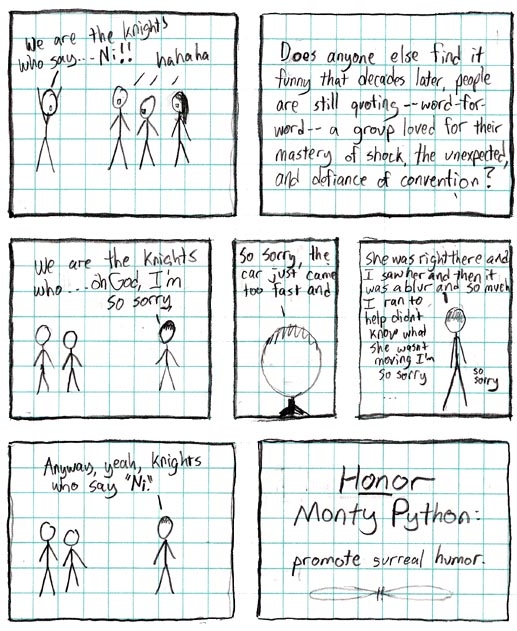
From xkcd:


Ni, Mr. Cage., Ni.

Thursday, December 2, 2010

The Distribution of Dominance

So, as you have no doubt surmised from the title of this post, the cash-strapped Republican Party is going to start using their abundant frequent "flyer" points to pay their debts.

I'm kidding, of course. The GOP doesn't pay its debts!

Actually, we're going to talk about a paper just out in Genetics by Aneil Agarwal and Michael Whitlock. They provide a very thorough analysis of data on the fitness effects of homozygous and heterozygous gene deletions in yeast.

But let's back up for a minute first.

The authors are interested in understanding the distribution of dominance, in the population-genetic sense. Traditionally, the dominance is represented by h, and the strength of selection by s. Usually, we define the fitness of the wild-type (hypothetically not carrying any mutations) as 1. Then, we consider the fitness effect of a mutation in a particular gene. In this case, we're going to focus on deleterious, or harmful mutations, which reduce fitness. If an individual carries two copies of the deleterious mutation, they have a fitness of 1-s, so that small values of s mean weak selection, and large values of s mean strong selection. The dominance refers to the relative fitness of an individual carrying only one copy of the deleterious mutation. This heterozygous fitness is 1-hs. If h equals 1, the deleterious mutation is completely dominant, meaning that having one copy of it is just as bad as having two. If h equals 0, the deleterious mutation is completely recessive, and having one defective copy of the gene is just as good as having two functional copies.

So, what is a typical value of h? Does it depend on s? How much does it vary from gene to gene? The conventional wisdom is that most deleterious mutations are recessive. This is why you should not have children with close relatives. I carry a bunch of recessive mutations, as does my wife. As long as we have different ones, our son inherits a bunch of mutations – but only one copy of each – so they're recessive in him as well. If we were closely related, we would carry many of the same mutations, and there would be a decent chance that our son would inherit two defective copies of the same gene, which could have various health consequences.


Charles Darwin and his first cousin Emma Wedgwood were married in 1839. 170 years later, they were portrayed by real-life-non-first-cousin couple Paul Bettany and Jennifer Connelly (not pictured).

However, population geneticists don't care about things like this just because of the implications for human disease. Dominance has a major impact on the eventual fates of individual mutations, and can influence other evolutionary processes, like speciation. Often, in order to model some other process, we have to make some sort of assumption about the distribution of fitness effects of mutations. Traditionally, a researcher would pull this distribution out of his or her asc. This is one of the biggest contributions that this paper will make to the field. It provides a nice, empirically based distribution of dominance effects that can feed into other evolutionary studies.

The results also confirmed (with much greater confidence than was previously the case) the relationship between h and s which had been suggested by some previous studies. They find that larger values of s tend to go with smaller values of h. Consistent with the conventional wisdom about not marrying your cousin, strongly deleterious genes tend to be pretty recessive. More surprisingly, most mildly deleterious mutations had fairly high h values. In fact, the mean value of h over all deleterious mutations was 0.8 – quite dominant. However, when the average is weighted by the fitness effect s, it drops to 0.2.

The authors also point out that this negative relationship between h and s has implications for the evolution of dominance. This pattern is most consistent with theories in which dominance is shaped by indirect selection. For example, deleterious mutations might be recessive if the protein produced by the gene were selected for overexpression to enhance a metabolic pathway, or to buffer the performance of that pathway in certain environments. Then, loss of one copy of the gene encoding that protein might not have a major effect on function (half of too much being still enough). Alternatively, recessiveness could come from feedback mechanisms that upregulate the functional copy of the gene when not enough of the gene product is being made.

The point is that in either of these cases (among others), recessiveness is driven by selection to maintain the function of the gene. The more important the gene is (the larger the value of s associated with it), the stronger this selection will be, and the more recessive deleterious mutations will become. Therefore, mechanisms like these predict the observed negative relationship between h and s.

On a historical note, this type of buffering process was proposed by one of the giants of population genetics, J. B. S. Haldane way back in 1930. Haldane passed away on December 1, 1964.

R. I. P., J. B. S.

Agrawal, A., & Whitlock, M. (2010). Inferences About the Distribution of Dominance Drawn from Yeast Gene Knockout Data Genetics DOI: 10.1534/genetics.110.124560

Tuesday, November 30, 2010

Concerning a Way for the Prolongation of Humane Life

So, Deare Readers of this Blogue, I hope that you will indulge me in reporting on an Interesting Idea published by the Royal Society in their Philosophical Transactions. I hope, Deare Reader, that you may also see fit to join me in Lauding said Society for having made their entyre back catalogue freely available to the publick this Month of November.

The Publication in Question, titled An Extract of a Letter Written by Monsieur de Martel of Montauban to the Publisher, Concerning a Way for the Prolongation of Humane Life, together with Some Observations Made in the Southern Parts of France, English'd as Follows, contains the author's reflections on the Causes of the Debilitation of Nature's strength in the course of man's life, and how these Causes might be Ameliorated, leading, naturally, to a means of achieving Eternal Youth through Medical Science.

The author agrees with the illustrious Messrs. Bacon and Sanctorius that the extinction of the natural heat and dessication of the Radical humour, as previously understood by Philosophers, seem not sufficient explanation for the causes of Age. However, Monsieur de Martel disagrees with Sanctorius's assertion that "the Fibres do dry up, that they can no more be renew'd," noting that even old Oxen have at certain times more or less marrow (though not, he is quick to point out, owing to the cycles of the moon).

Blood, claims Monsieur de Martel, is the Principle of Life, but notes that a Man typically has no Shortage of Blood when he dies. What causes this man to age, then, is that the Veins and Arteries which inclose the Blood, much like the Chymists Furnace, develop apertures, which, being insufficiently repair'd, do ease the dissipation of the igneous particles, such that they abandon the Blood. He reasons, then
 As in Stuffs and Cloth (whose woof is in manner like that of the Tunicles) the Threds by wearing do loosen and break, insomuch that many holes are made in it as in a Sieve. So that, if we had the Art to reinforce and to strengthen anew those Coats and Membranes, that they might not let slip what maketh the blood vital, the life would be preserved perpetually. . . . There is no reason to despair of finding out such Medicins, or Ailments, as are proper to strengthen the Coats and Membranes of the Vessels, so that they may at all times retain the fiery and spirituous corpuscules of the blood, as well as in the time of Youth.
The author also reports on the method of making Muscadin Wine in Frontignac.

For those wishing further to pursue Monsieur de Martel's ideas on the Acquisition of Eternal Youth through preservation of the blood's vital igneous particles, or those wishing to instruct their Slaves on how best to produce a nice Muscadin, the citation information is:

de Martel, M. (1670). An Extract of a Letter Written by Monsieur de Martel of Montauban to the Publisher, Concerning a Way for the Prolongation of Humane Life, together with Some Observations Made in the Southern Parts of France, English'd as Follows Philosophical Transactions of the Royal Society of London, 5 (57-68), 1179-1184 DOI: 10.1098/rstl.1670.0020

Wednesday, November 24, 2010

Irony Alert: Marc Hauser on moral judgments

So, PNAS has just published a brief exchange on the nature of moral judgments, including a letter where one of the coauthors is the man who put the a** in a**ertainment bias.

Marc Hauser is a Professor in the Psychology Department at Harvard. He made a name for himself publishing a variety of behavioral and cognitive studies on both humans and non-human primates, with the goal of understanding the evolutionary origins of human cognition, including complex traits such as language, economic decision-making, and moral judgments. More recently, he has made a name for himself by allegedly falsifying data and allegedly bullying the people in his lab who naively thought that the data published by the group should be . . . I don't know . . . NOT falsified. I won't repeat what this more recent name that he's made for himself is, as it would violate the norms of internet civility. Over his career, Hauser has published something like 200 articles and 6 books, many of which probably contain certain things that are not entirely false. At the moment, he is on leave from Harvard, following an investigation's finding him solely responsible for 8 counts of scientific misconduct. Presumably, he is working on his next book, allegedly titled Evilicious: Explaining Our Evolved Taste for Being Bad.

Snarking aside, the two letters that were just published follow from an interesting article published in PNAS earlier this year, where Hauser is the third of four co-authors. For those not familiar with authorship conventions in biology and related fields, here is what is typically implied by the order of authorship on a four-author paper. The first author probably did all of the experiments. The second author helped with some of the experiments, and/or some of the data analysis. The third author probably didn't directly participate, but contributed ideas and/or reagents and/or equipment. The last author probably runs the lab where the experiments were done. In fact, the other three authors are all at the other Cambridge, in England, where the experiments were actually done. I point all this out just because I don't want to leave the impression that we should be suspect of the results in the paper just because Hauser's name is on it.

The original paper, which can be found and freely downloaded here, tests the effect of enhancing serotonin activity on a variety of tasks or decisions, some of which had a moral flavor. Serotonin enhancement was achieved by giving some of the subjects the drug citalopram, which is a selective serotonin reuptake inhibitor (SSRI), like Prozac or Zoloft. The finding was that enhancing serotonin made subjects less willing to take an action that required them to inflict harm on another individual in an emotionally salient context.

This work fits in with a substantial literature on moral dilemmas. I'll just briefly outline the gist of that literature here in the context of one particular dilemma that often makes an appearance in these studies. The scenario is this: there are five people tied to a train track, and there is a train rushing towards them. You have the opportunity to save them, by stopping the train or switching it to a different track, but the only way to do it involves killing one person. What do you do?

Most people find that they have two conflicting impulses. On the one hand, killing one person to save five makes sense from a utilitarian perspective. That's four fewer dead people. On the other hand, you are the one who has to kill the one person, and most people feel a moral repulsion to killing someone, even if it is for the greater good.

In these studies, which of the two impulses seems to win depends on how personal the killing is. If all you have to do is pull a switch, and the train will go on another track, which, for unknown reasons, has one person tied to it, the killing is fairly impersonal, and many people will choose this utilitarian, four-fewer-dead-people option. On the other hand, if the only way to stop the train is to chop off someone's head and throw it through a magical basketball net woven of human entrails (I'm making this up), many people will find this too emotionally and morally problematic, and will let the train go on its merry five-corpse-making way. Researchers have mapped out a whole continuum between these two extremes: pushing someone off a bridge with your hands is more emotionally salient (and therefore less morally acceptable) than pushing someone off a bridge with a stick, and so forth.

What the original paper finds is that giving someone an SSRI does not have much effect on decisions that are morally neutral, or where the harm that must be inflicted is impersonal (like throwing a switch to divert the train). However, in cases where one decision would require the subject to harm someone in a personal and emotionally salient way (like pushing them off the bridge with their bare hands), the SSRI seems to enhance the emotional/moral aversion to taking that action.

So, in addition to nausea, insomnia, and diarrhea, add to the list of possible side effects of antidepressants: "may reduce willingness to harm others in emotionally charged situations." Maybe Charlie Sheen should be on one of these.

The letters commenting on the original paper can be found here and here, but require a subscription to PNAS to access. I wouldn't go to great lengths to get them, however. There is some quibbling about terminology – driven more by a commentary on the original article than by the article itself – and some tiresome academic "Get off my lawn!" moments, but probably nothing of interest to most of the reader(s) of this blog.

Crockett MJ, Clark L, Hauser MD, & Robbins TW (2010). Serotonin selectively influences moral judgment and behavior through effects on harm aversion. Proceedings of the National Academy of Sciences of the United States of America, 107 (40), 17433-8 PMID: 20876101